FAQ: What Home Air Purifier Should I Get?
Short Answer:
If you just want a recommendation without all the details these are brands I've had first-hand experience with, in order of personal preference:
Coway Airmega Levoit LAP-C161 Blueair 311i Max Rabbit Air MinusA2
TL;DR:
Get the right size for your space. Prioritize high CADR and low cost. Use other reviews and resources for reliable picks. Don’t forget to consider replacement filter costs, ease of replacement, AND noise. Stick with HEPA filters, MERV-13 filters, or verified mechanical filtration. If it zaps, shocks, or claims to “energize” your air—it’s might be doing more harm than good. Consider a low cost DIY option (CR Box) if you want an IAQ project. Add a continuous monitor if you want to track your air quality over time. For commercial spaces, think bigger (it's complicated). Let's talk!
The Rest of the Story...
Whether you're buying an air purifier for your home or your office, the most important factor is how well it cleans the air. That’s usually measured by CADR (Clean Air Delivery Rate). But other things matter too, like cost, noise, filter replacement frequency, and ease of maintenance.
Let’s walk through how to choose:
1. Size Matters (Start with your room size)
Air purifiers are rated by how many square feet they can handle. Make sure the unit you’re buying is powerful enough for the actual size of your space. Bigger room = bigger purifier (or multiple smaller ones).
2. Look for a High CADR
The CADR tells you how fast the unit can clean the air of smoke, dust, and pollen. You want a high CADR relative to the room size. More cleaning power = better performance.
3. Compare Total Cost
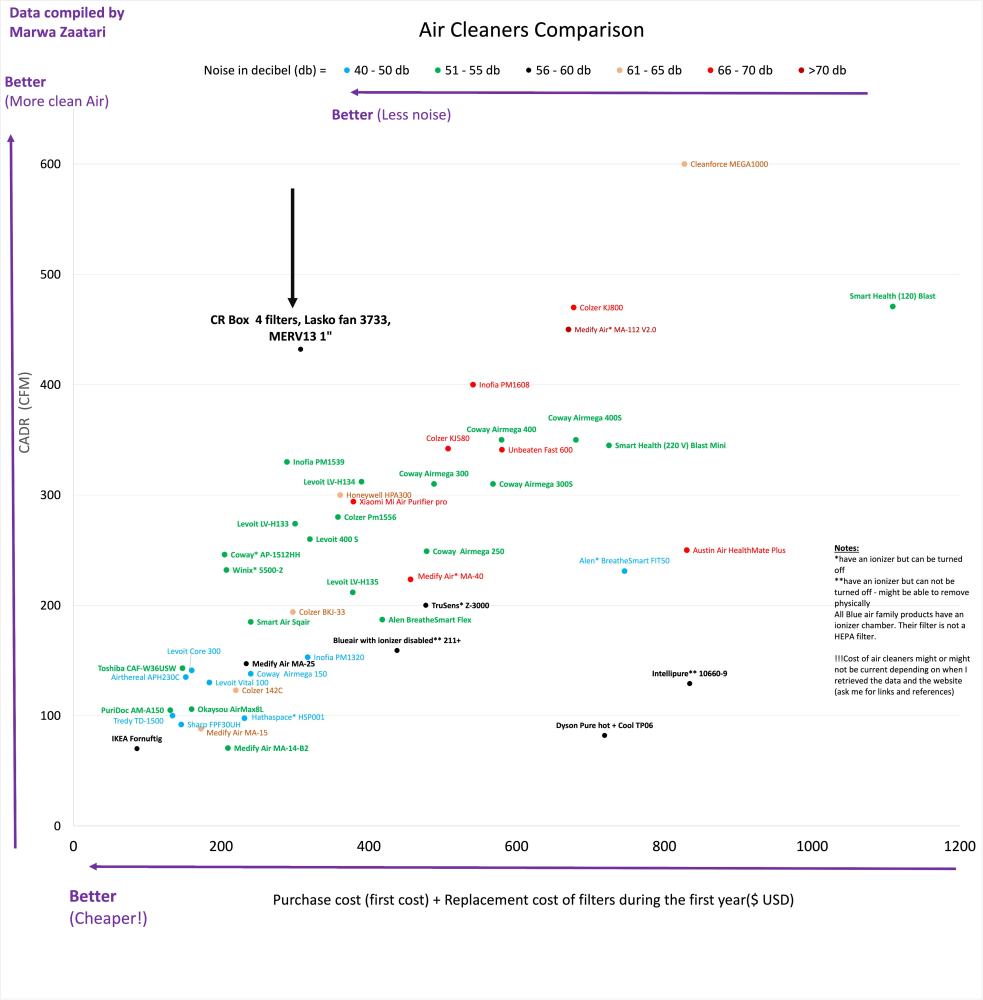
Look at the initial cost + yearly filter replacement cost. A cheaper purifier with expensive filters might cost more in the long run. Marwa Zaatari (a collaborator and respected expert in indoor air quality) put together a helpful comparison chart (below) showing the best bang for your buck based on CADR vs. cost.
4. Consider the Noise
If it’s for a bedroom or office, noise matters. In Zaatari’s chart, dot color indicates sound level. So you can choose something quieter. Pro tip: use multiple smaller purifiers on low settings to reduce noise and still get clean air.
5. Search the AHAM Verifide Database
Want to do your own search? Use AHAM’s searchable directory for certified units. It’s one of the best ways to verify that you’re getting a reliable, tested purifier.
What about Carbon Monoxide, Radon, Mold?
None of these monitors detect any of those things. If you don't already have a carbon monoxide detector, GET ONE, especially if you use any kind of combustion (gas furnace, range, fireplace, etc.) We could also get into radon and mold while we're here, but those are topics for another time. Note that these are serious health items that go beyond basic air quality and not addressed by air purifiers at all.
Optional Extras for the Indoor Air Nerds (Like Me)
Use a Healthy Skepticism with Ionization
Keep an eye out for devices that include ionization, ozone generators, or “plasma” technologies. Ionizers work by electrically charging particles so they stick to surfaces or get collected on internal plates. It sounds high-tech, but in practice, there can be some potential problems.
Ozone risk: Many ionizers create ozone as a byproduct. Even low levels of ozone can irritate lungs and worsen asthma. Not as effective: Ionizers generally don’t remove particulates as well as HEPA filters. They may reduce airborne particles slightly, but not nearly to the degree that HEPA-based systems do. Hard to verify performance: It’s often unclear how much air is being cleaned - and how well.
How to spot them... Watch for terms like: Plasma / plasmawave, Ionic purifier, Negative ion generator, Electrostatic precipitator, Ozone-enhanced.
If a unit doesn’t list its CADR, or if it emphasizes “odor removal” and “fresh air” without clear filtration specs, it’s worth a second look.
Consider Continuous Monitoring
If you're already investing in air quality at home, a monitor can help you make sure your purifier is working well:
Airgradient is an excellent open-source low cost monitor, which you can purchase fully assembled or as a kit (the link here is my affiliate link). Awair Element or Airthings View Plus are solid consumer-grade options. Kaiterra offers a full suite of commercial building monitors with a range of options. Prioritize monitors that track: Carbon Dioxide (CO2), Particulate Matter (typically PM2.5), and TVOC (total volatile organic compounds).
Awair: Dirty Water (YouTube)
What If This Is a Commercial Building Instead of a House?
Things change a bit when you're dealing with larger, shared spaces and commercial building typologies... complicated and interconnected HVAC systems, ventilation requirements, occupancy, controls, and ambient conditions. Frankly this is a HUGE topic. So... not fully covered in this post.
But if we're talking about using portable 'in space' air purifiers inside commercial buildings, some of the same rules above apply. In general.
What About a DIY Option? Meet the Corsi-Rosenthal Box
If you’re looking for an affordable, effective, and even kind of fun DIY air purifier project, the Corsi-Rosenthal Box might be your new best friend. The CR Box is a homemade air cleaner built from:
1 standard box fan 4 (or 5) MERV-13 furnace filters Some cardboard and duct tape [That’s it.]
How to Build a Corsi-Rosenthal Box (YouTube)
It works on the same principle as commercial purifiers: pull air through a dense filter to capture particles like dust, smoke, pollen, and even some viruses. MERV-13 is widely recommended for particle filtration, and the large surface area of the box allows for quiet and efficient air movement.
Incredible CADR for the price - often better than many $500+ machines Great for classrooms, dorms, basements, and offices Easy to build (plenty of YouTube tutorials - like the one above!) Can be decorated by kids or coworkers - makes a great STEM project
Limitations to note:
It’s big and boxy—not for the design-conscious. No VOC or gas filtration—just particulate (which is fine for most people). You’ll want to replace filters every 3–6 months, depending on use.
If you’re in a pinch, on a budget, or just love a good DIY moment, this is a solid option that punches way above its weight.
Want help choosing a purifier for your home, office, or school? I'm always happy to geek out over airflow. Until next time!