UV Systems Aren’t All the Same: Here’s What to Ask Your Engineers
UV-C systems have become a go-to strategy for improving indoor air quality, reducing maintenance costs, and supporting decarbonization by keeping coils cleaner and HVAC systems more efficient. They show up both in new construction and retrofit applications in buildings of all types (for good reason).
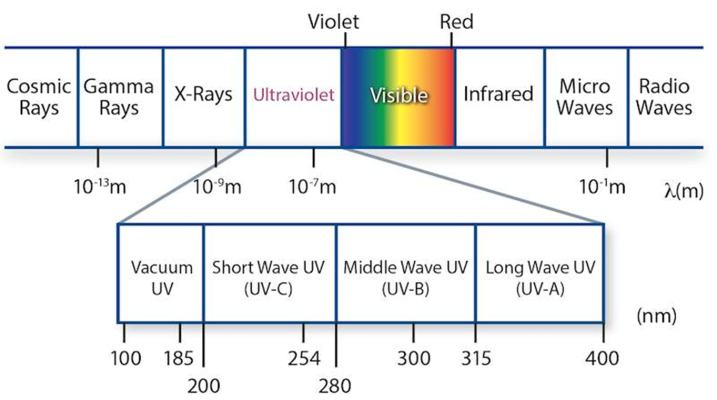
Short-wave UV light (UV-C) has been used for nearly 20 years in buildings , and had a big upswing as a result of the COVID-19 pandemic. In addition to coil and airstream irradiation, many other systems like upper-air irradiation, and portable devices have hit the market. When we're talking about UV light here, this is how it relates to the whole spectrum of light:
Why This Matters for Healthy Buildings & IAQ
UV-C is now a foundational technology for: cleaner coils (which improves HVAC efficiency and reduces carbon), microbial control, improved indoor air quality, reduced maintenance cycles, and guidelines for infection risk reduction.
But only if it works as designed.
And right now, too many UV systems don’t. Simply because they weren’t specified with the right data. So while specifying UV-C lamps for HVAC systems are known to require attention to exposure time, space considerations, coil size, system component durability., and maintenance considerations... here’s the part many owners and architects, and even engineers, don’t know:
Most UV lamps don’t perform in real-life the way they're shown to based on published manufacturer data.
Recent testing from ASHRAE Standard 185.2 (Method of Testing Ultraviolet Lamps for Use in HVAC&R Units or Air Ducts to Inactivate Microorganisms on Irradiated Surfaces) as described in the Sept 2025 ASHRAE Journal confirmed these fundamental truths about UV-C:
👉 Every UV lamp lost intensity at real-world temperatures (Especially at low temps common in cooling seasons)
👉 Many lamps underperformed manufacturer ratings by 20–70% At 55°F (common coil temps), some lamps dropped over 70% in intensity.
👉 Only one UV lamp hit its rated output at test conditions
👉 Temperature and airflow dramatically change UV-C output Most lamps deliver high intensity only in idealized lab conditions (72-75°F, no airflow).
The good news? This is totally solvable... as long as you ask the right questions.
What Designers Need to Know
1. Temperature Matters
At 55°F (coil-adjacent temperatures), lamp intensity fell dramatically. For several lamps, this meant less than half the expected germicidal dose.
Design implication: If your system is intended to disinfect coils or air under cool conditions, you must select lamps tested under those same temperatures: not 72°F spec-sheet values.
2. Airflow Hurts UV Output
Standard 185.2 includes varying air velocities (0–2,000 ft/min). At higher velocities, intensity reductions were significant across lamp types.
Design implication: For in-duct UVGI, specify lamps using intensity values measured under airflow conditions that match your system. Otherwise, you risk massive underperformance.
3. LEDs Aren’t a Silver Bullet
The 265 nm LED tested showed low intensity and steep reduction at high temps (up to 18% loss at 120°F), and it required substantial heat sinking.
Design implication: LED UV-C has promise for the long term — but for now, don’t assume it performs better than fluorescent UV-C for HVAC applications.
4. Lamp Type Matters (Especially Filament Length)
Short-filament and long-filament lamps behaved differently under temperature swings:
• Short-filament lamps had higher peak intensities • Long-filament lamps showed better stability at elevated temps
Design implication: Match lamp type to project conditions — coils vs air-stream, temp profiles, and required disinfection efficiency.
5. UVGI Effectiveness Is Tied to D90 Exposure Time
ASHRAE 185.2 includes D90 calculations (time to achieve 90% reduction of Influenza A at specific intensities).
At 55°F, times were up to 2–3× longer than expected.
Design implication: If UVGI effectiveness is a project goal, you need to confirm that D90 times reflect real HVAC temperatures — not idealized lab conditions.
So What Should Designers Do Differently?
Here’s the short list:
✔️ Reference ASHRAE 185.2 test data, not only manufacturer spec sheets
✔️ Use intensity values measured at temperatures matching your application
✔️ Check performance across airflow velocities, especially for in-duct UVGI
✔️ Integrate D90 exposure times into design calculations
✔️ Ask for third-party performance data
✔️ Design for worst-case seasonal performance, not best-case
Why This Matters for Your Buildings
You don’t need to speak engineer. But you do deserve systems that work the way you expect.
Smart questions help ensure the UV systems you’re investing in, actually deliver... better indoor air quality, cleaner coils (and lower energy use), healthier, more resilient spaces, alignment with IAQ commitments, WELL/Fitwel strategies, plus reduced maintenance and downtime.
All said, UV-C can be a powerful tool.
Just make sure it's designed correctly.