Where the Sidewalk “Fails”... The Carbon Cost of Replacing What We Could Probably Repair
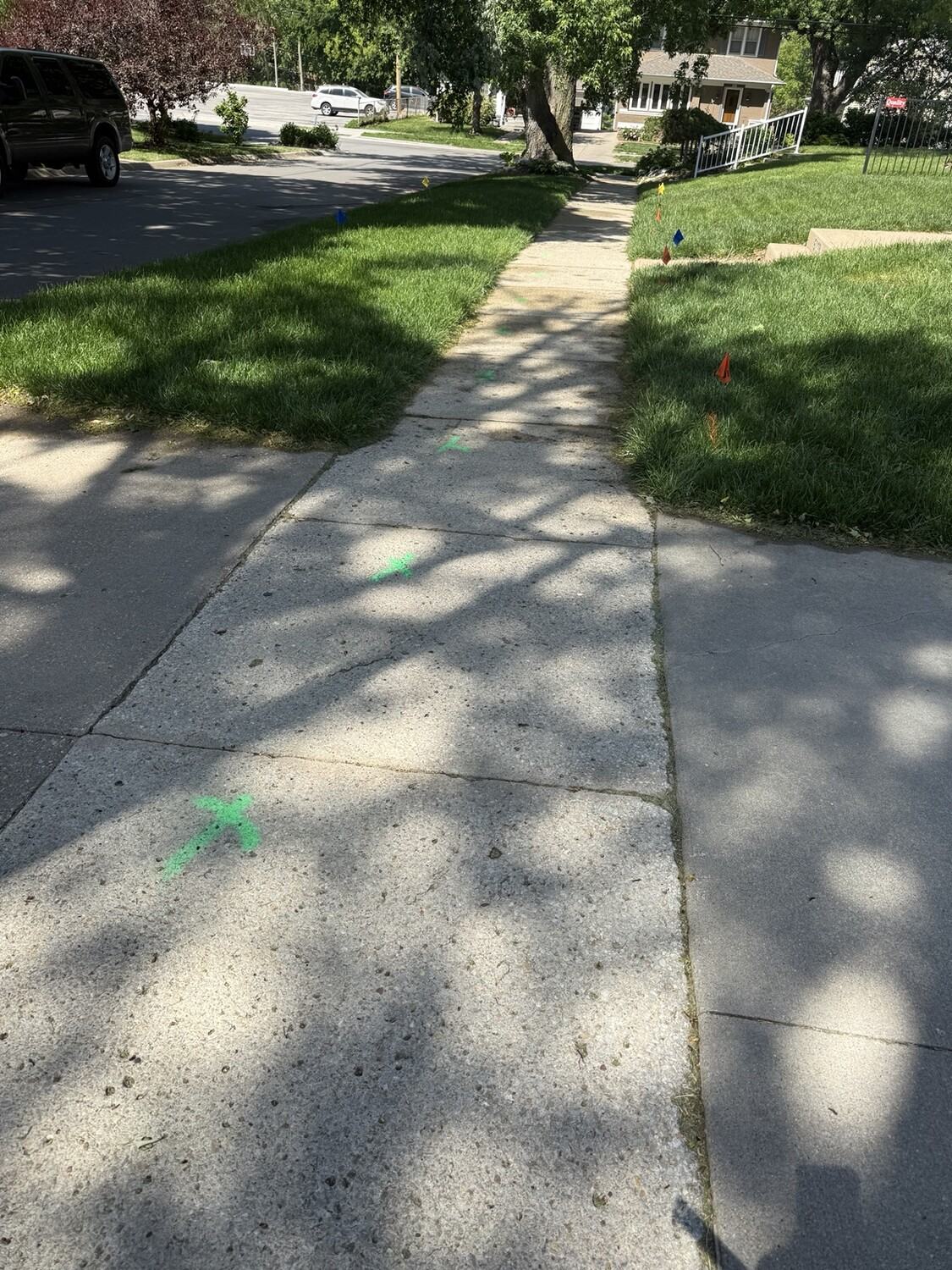
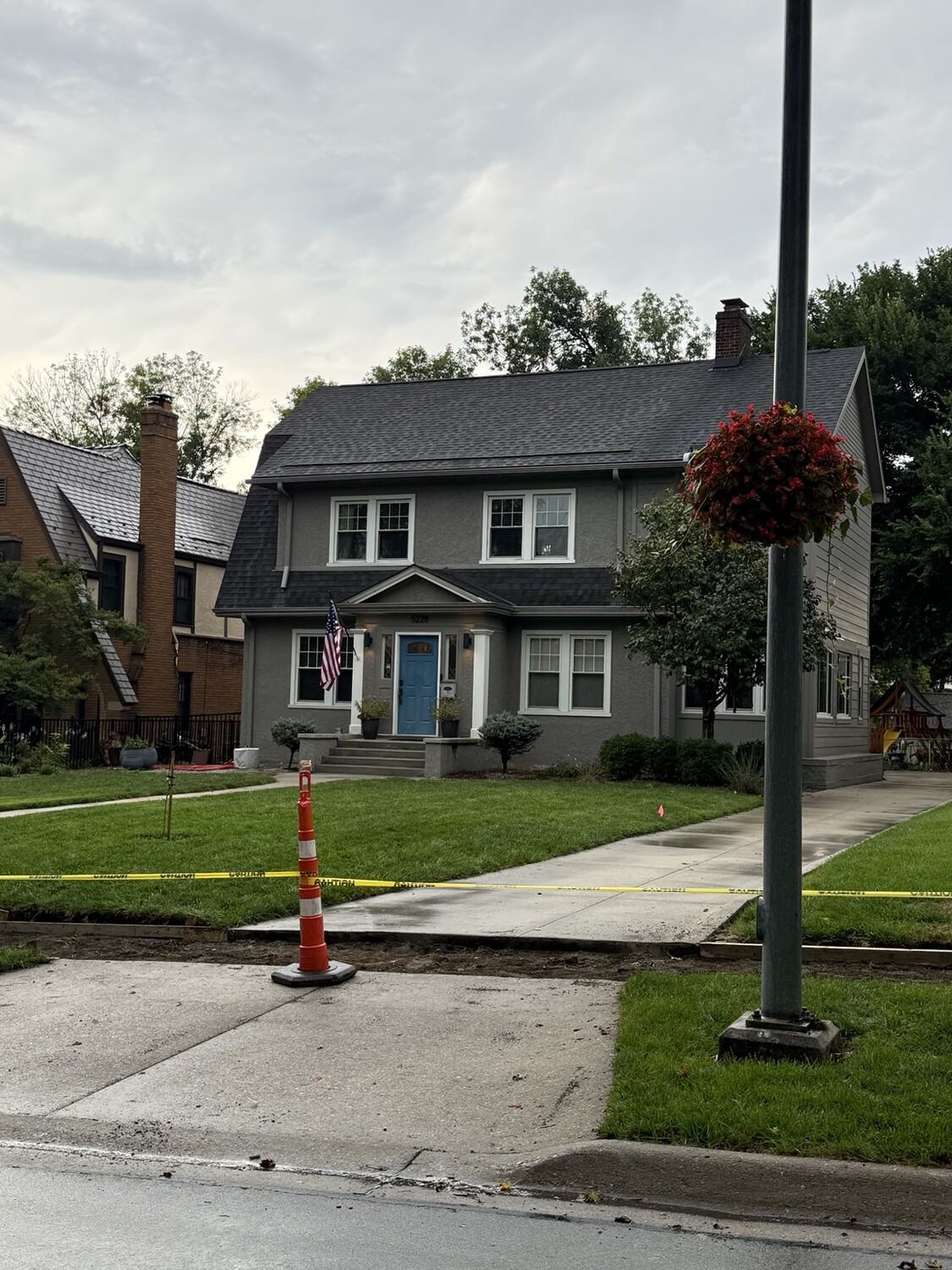
Back in May, way back when summer was just kicking off, the City of Omaha painted green X's on the sidewalk in front of my house. And a bunch of my neighbors.
Then I got the letter.
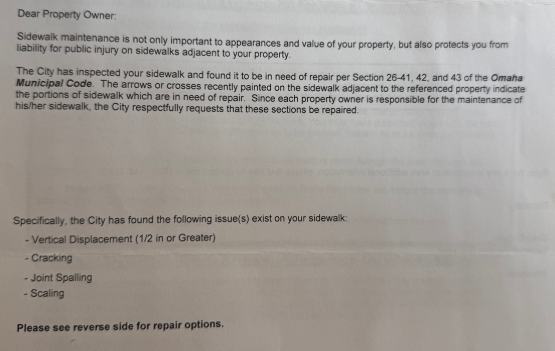
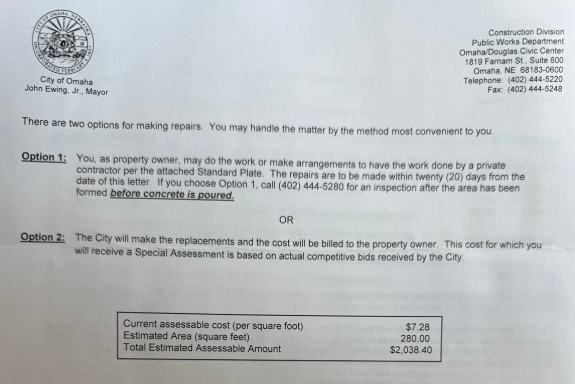
The City had inspected the sidewalks and identified a list of unacceptable conditions: vertical displacement of one-half inch or greater, cracking, joint spalling, and/or scaling. Under Omaha's municipal code, maintaining the sidewalk adjacent to a property is the property owner's responsibility. I could hire my own contractor and complete the work to City standards, or I could allow the City's contractor to do it and pay the resulting special assessment.
The City's estimate was straightforward: 280 square feet at $7.28 per square foot, for an estimated cost of $2,038.40.
In a roundabout way, I eventually chose the City contractor.
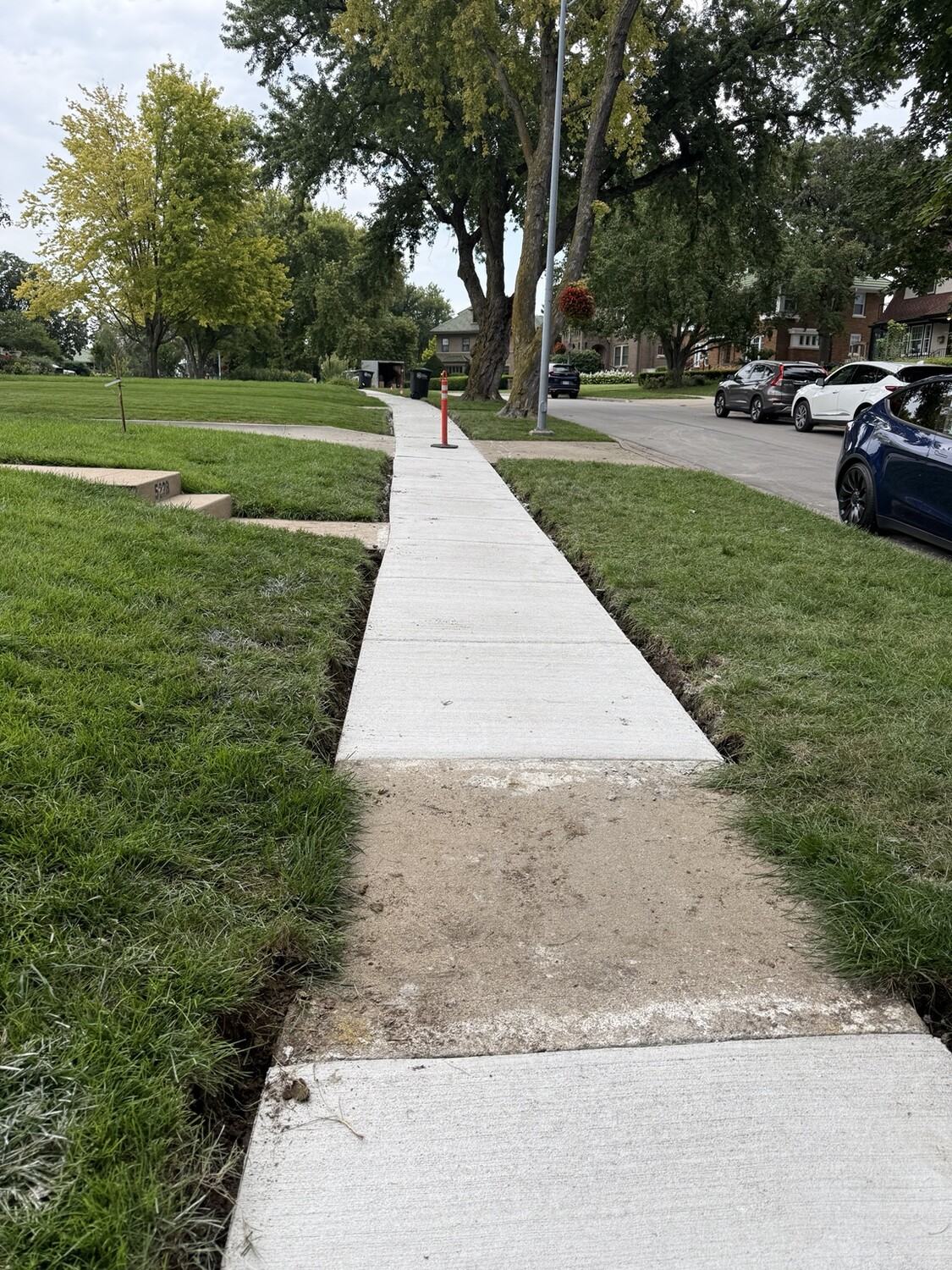
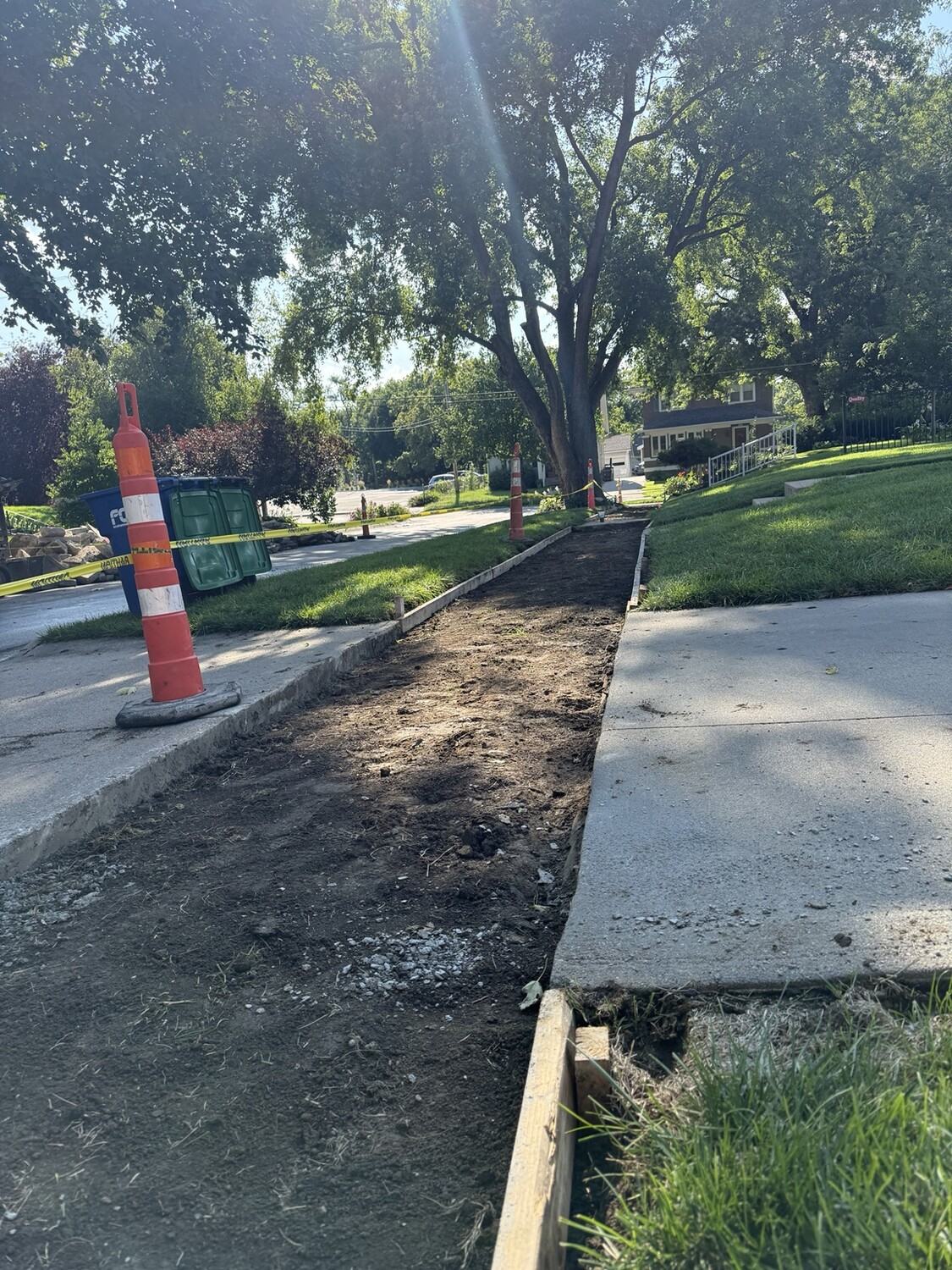
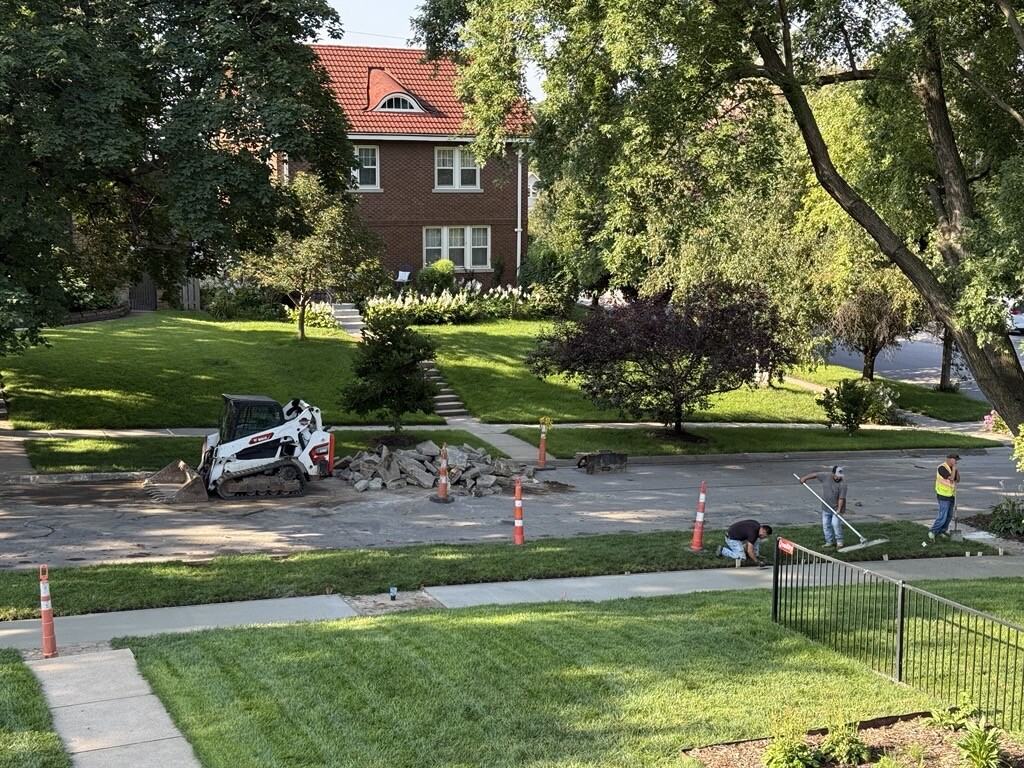
And then, last week, as a weird endcap to the summer... nearly my entire sidewalk disappeared and reappeared in the span of a single day.
Of all the existing sidewalk along my property, one panel was left in place.
The sidewalk certainly had flaws. There were cracks. There was surface deterioration. There were locations with displacement. I don't dispute the City's inspection or the need to address conditions that create accessibility problems or trip hazards. (Me of all people knows this).
And I'm an engineer. So of course I understand why standards exist.
But I'm also a sustainability consultant, and watching a substantial amount of functional concrete get broken apart and hauled away raised a different question:
Are we defining infrastructure failure in a way that makes sense, in a carbon-constrained world?
The sidewalk wasn't perfect. But was it "finished"?
There is an important distinction between a material having defects and a material having reached the end of its useful life.
We make this distinction routinely in buildings.
An air-handling unit with a failed fan doesn't necessarily need to be fully replaced. A building envelope with localized water intrusion doesn't automatically require a new façade. A boiler operating below its original efficiency doesn't necessarily belong in a landfill.
We diagnose the problem, consider remaining useful life, evaluate repair and replacement alternatives, and ideally make a life-cycle decision.
Infrastructure deserves the same thinking.
In my case, the City's inspection identified several types of deterioration across the sidewalk. And Omaha's sidewalk construction standard includes an important constraint: "No sidewalk repair shall be less than one complete panel." That requirement is entirely understandable from a constructability and durability standpoint. Tiny patches in concrete flatwork are unlikely to be a good long-term solution.
But once full-panel replacement becomes the minimum unit of intervention, a relatively small defect can trigger replacement of a much larger quantity of material.
Multiply that logic across a neighborhood, a city, and eventually thousands of miles of municipal sidewalks, and a mundane maintenance standard becomes a materials and carbon policy... Whether we intended it to or not.
So I did some carbon math
The City's estimate identified 280 square feet of sidewalk for repair.
Omaha's standard sidewalk detail calls for a minimum concrete thickness of 4 inches.
That means the replacement represented approximately:
280 sf × 4/12 ft = 93.3 cubic feet or about 3.46 cubic yards of concrete.
And it probably goes without saying that nobody supplied me with an Environmental Product Declaration (EPD), for the concrete mix used at my house. (An EPD is essentially a standardized environmental nutrition label for a building product). Among other things, it reports the product's global warming potential, or GWP, generally expressed as kilograms (kg) of carbon dioxide equivalent (CO2e).
The Carbon Leadership Forum 's North American material benchmarks, based on data from the National Ready Mixed Concrete Association , report North Central regional production-stage GWP values of approximately 264 kg CO₂e per cubic meter for 3,000 psi concrete and 312 kg CO₂e per cubic meter for 4,000 psi concrete.
My 3.46 cubic yards is approximately 2.64 cubic meters. So that puts the production-stage carbon associated with the replacement concrete at roughly 0.7 to 0.8 metric tons of CO₂e.
Or about 1,500 to 1,800 pounds of carbon dioxide equivalent.
And that's not a full accounting.
Those figures represent the product stage, generally referred to as life-cycle stages A1 through A3: raw-material supply, transportation to manufacturing, and manufacturing. They don't capture the complete impact of the work I watched happen in front of my house:
Not the equipment that demolished the old sidewalk. Not hauling away approximately 3.5 cubic yards of old concrete. Not processing, recycling, or disposal. Not transporting the new concrete to my house. Not construction equipment or site restoration. And, perhaps most importantly, not the remaining embodied value of the concrete that was already there.
So 0.7 to 0.8 metric tons isn't "the carbon footprint of my sidewalk project." It's a conservative estimate of one piece of it.
The carbon we don't count is the material we already own
This is where infrastructure maintenance intersects with one of the most important ideas in building decarbonization: The greenest material is usually the material you don't have to manufacture again.
That doesn't mean "never replace anything."
It means existing materials should have value in our decision-making.
The Federal Highway Administration , or FHWA, is the federal agency responsible for supporting the nation's highway transportation system, and it recognizes this principle in pavement management. Its sustainable pavement guidance treats preservation, rehabilitation, recycling, and end-of-life management as distinct parts of the pavement life cycle. FHWA research specifically recognizes that appropriate preservation strategies can extend the service life of existing concrete pavement rather than defaulting to complete reconstruction.
That is fundamentally a life-cycle approach.
And it raises an interesting question at the much smaller scale of sidewalks.
What would happen if municipal sidewalk programs incorporated not just: Does this panel meet the standard today?
but also: What is the lowest-impact intervention that can restore acceptable performance for an appropriate service life?
Those aren't the same question.
What else could "repair" mean?
There are good reasons cities like replacement.
Replacement is predictable.
It creates a known surface. It can address slope and displacement. It eliminates cracking and deterioration instead of managing them. Contractors know how to bid it. Inspectors know how to inspect it. Municipalities can apply a consistent standard across thousands of properties.
There is real value in that simplicity.
And accessibility cannot become collateral damage in the pursuit of embodied-carbon reductions. A half-inch vertical displacement can be a meaningful trip hazard. A sidewalk is public infrastructure, even when the adjacent property owner is financially responsible for maintaining it.
But the alternative to wholesale replacement isn't necessarily "leave the bad sidewalk alone."
There is a spectrum between do nothing and demolish and replace.
Depending on the cause and condition, that spectrum can include techniques such as grinding localized vertical offsets, slab lifting or stabilization, joint and crack repair, surface treatments, selective full-panel replacement, or combinations of those strategies.
Not every technique is appropriate for every defect. Grinding won't solve severe structural failure. Lifting a badly deteriorated slab may simply postpone replacement. Patching can perform poorly if the underlying failure mechanism isn't addressed.
That's precisely why this should be an engineering decision rather than a binary one.
The FHWA defines pavement preservation around maintaining the existing pavement structure and extending its service life. Its guidance also cautions that preservation treatments have to address the actual deterioration mechanism rather than simply masking symptoms.
Preservation isn't automatically sustainable. Neither is replacement.
The question is which intervention provides the required performance with the lowest life-cycle environmental, economic, and social cost.
What if we had saved half of it?
We can't reconstruct a hypothetical engineering evaluation after the sidewalk has already been demolished, and I don't know which individual panels could have remained in service for another 5, 10, or 20 years.
But we can use the carbon calculation to understand the scale of the opportunity.
If an alternative repair strategy could have retained half of the 280 square feet, the avoided production-stage emissions from new concrete alone would have been approximately: 350 to 410 kg CO₂e. If 75% could have remained, the avoided production-stage emissions would have been roughly: 525 to 620 kg CO₂e.
And those savings would occur before counting avoided demolition, hauling, processing, and construction impacts.
Replacing the sidewalk in front of my house represents roughly the climate impact of driving an average gasoline car somewhere between Omaha and New York City, depending on the assumptions used. That's roughly equivalent to driving an average gasoline vehicle 900–1,500 miles. Not exactly a climate catastrophe.
But municipal infrastructure isn't one sidewalk. Cities manage millions of square feet of public infrastructure.
And that's why seemingly mundane maintenance standards matter.
I couldn't find readily available data showing how many square feet of sidewalk Omaha replaces annually. (That's actually one of the numbers I'd now like to know).
Imagine 1,000 or 10,000 similar sidewalk projects.
If better condition assessment and preservation strategies avoided even 25% of that new concrete, the savings become meaningful.
The exact numbers would obviously depend on sidewalk conditions, concrete specifications, local EPD data, contractor practices, transportation distances, and the service life achieved by each repair strategy.
But that's exactly the point.
We should be measuring those things.
Our standards encode yesterday's optimization criteria
It's not that public works standards were written badly. They were written to solve the problems we asked engineers to solve. (And I say this all the time... we engineers are taught to be REALLY good at solving problems).
Make infrastructure safe. Make it durable. Make construction repeatable. Make bidding straightforward. Make inspection enforceable. Control costs. Reduce liability.
But now we have another constraint... Carbon.
The built environment consumes enormous quantities of materials, and every time we manufacture cement, steel, asphalt, glass, insulation, or any other construction material, there is an environmental cost associated with it.
The engineering challenge of the next several decades isn't simply figuring out how to make new things with lower-carbon materials.
It's also figuring out how to stop replacing existing things before we need to.
That's true for a 500,000-square-foot office building. For an air-handling unit. And it's true for the sidewalk in front of my house.
Spoiler... This isn't really an article about my sidewalk
The new sidewalk looks great. It is flat. It is uniform. The trip hazards are gone. It meets the City's requirements. And the contractor did exactly what the system asked them to do.
This isn't a criticism of the crew pouring concrete in front of my house.
It isn't even an argument that the City made the wrong decision under its current standards.
It's a question about whether the standards themselves should evolve.
The City of Omaha's code gives it authority to require sidewalk repair and assess those costs to the adjoining property owner. Its standards establish how those repairs must be constructed. That's how municipal infrastructure management works, and consistency is important.
But consistency and optimization aren't necessarily the same thing.
What if the next generation of municipal maintenance standards incorporated:
A condition-based assessment rather than primarily defect-based assessment; An explicit hierarchy of preserve, repair, rehabilitate, replace; Approved techniques for correcting localized displacement without replacing otherwise serviceable slabs; Life-cycle carbon alongside first cost and service life; Environmental Product Declarations for concrete purchased through municipal contracts; Performance-based concrete specifications that allow lower-carbon mixes where appropriate; Documentation of demolition quantities and the destination of removed concrete; and a requirement to evaluate existing material as an asset before treating it as waste?
That wouldn't mean tolerating unsafe sidewalks.
It would mean applying the same engineering rigor to whether we demolish something that we already apply to how we build its replacement.
The most sustainable concrete might be the concrete that's already there
There is a tendency in sustainability work to focus on the "exciting" stuff.
New low-carbon concrete mixes. Carbon-cured materials. Electrified construction equipment. Alternative binders. Carbon capture. We need these innovations.
But sometimes decarbonization is much less glamorous.
Sometimes it's an person standing in front of a broken thing and asking: "Does this actually need to go?"
Because every existing building, road, sidewalk, structural frame, duct system, pipe, and piece of equipment represents carbon we've already spent.
We can't get that carbon back.
But we can decide how long we keep the asset it bought us.
In front of my house, 280 square feet of sidewalk was identified for repair. Almost all of it was removed. A new sidewalk now sits in its place, carrying somewhere on the order of three-quarters of a metric ton of new production-stage embodied carbon.
Maybe replacing all of it was the right life-cycle decision.
Maybe it wasn't.
The problem is that carbon wasn't part of the decision.
And increasingly, I think it needs to be.